


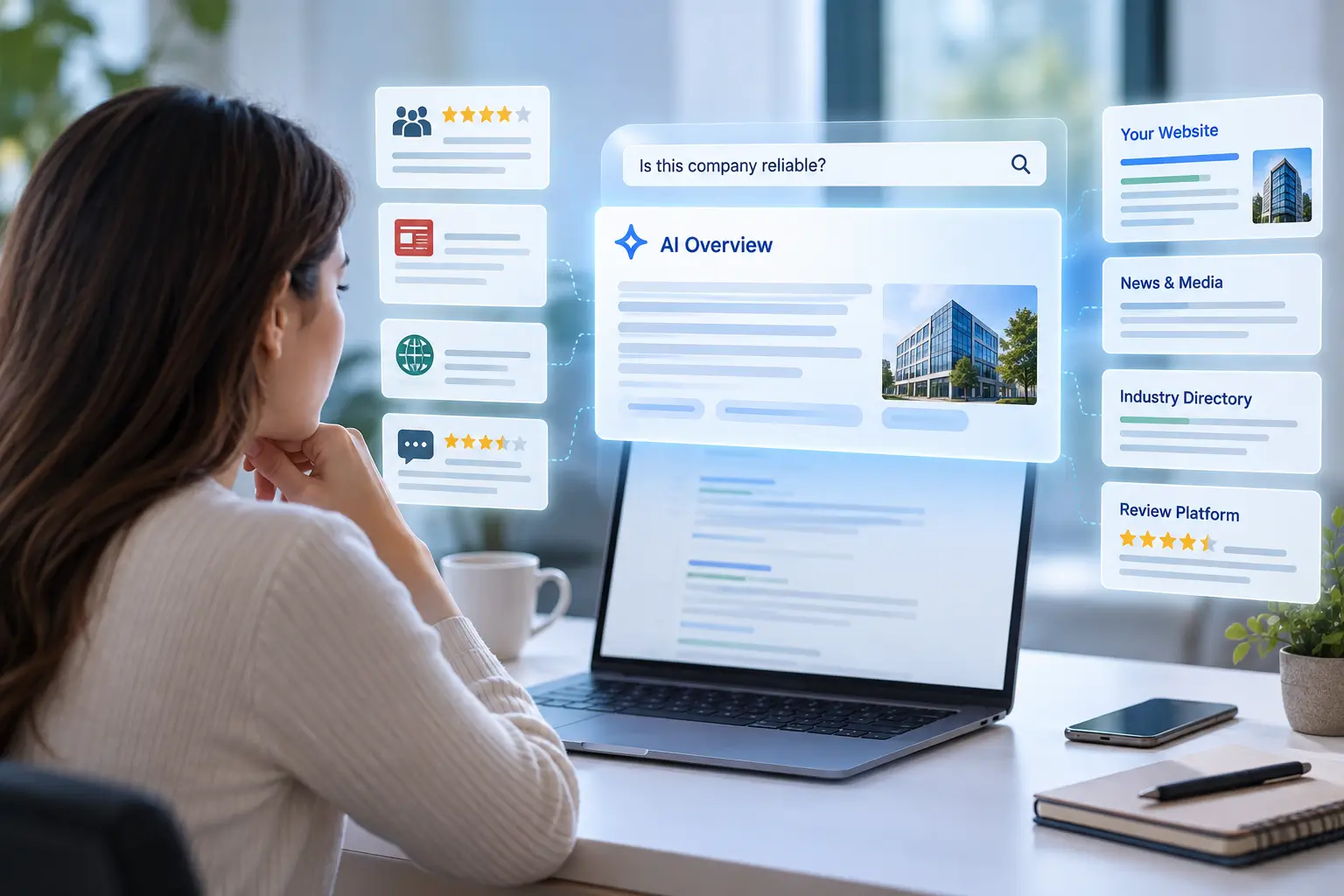
AI Overviews and generative search are changing brand reputation management by shifting how customers form their first impression of a business. Instead of browsing multiple search results, users now read a single AI-generated summary that pulls from reviews, articles, and third-party sources, often without visiting your website at all. This means your brand’s reputation increasingly depends on what AI tools find across the web, not just what you publish on your own site.
Search behavior has shifted quickly. A growing number of queries now end with an AI-generated answer instead of a list of links to click through. For brand reputation specifically, this creates a new reality: the first impression a potential customer forms often comes from a machine-written summary, not your website, not your social media, and not even a review page they read in full.
This guide explains what’s actually different about AI Overviews and generative search, why this shift matters for brand reputation right now, how AI tools decide what to say about a business, and what companies should start doing today to adapt
What’s Actually Different About AI Overviews and Generative Search?
Traditional search results show a ranked list of links, giving users the choice to click, compare, and decide who to trust. AI Overviews and generative search tools work differently. They read across multiple sources and generate a single summarized answer, often citing only two or three references directly.
This shift matters because it removes the comparison step. A user asking about your brand no longer sees ten separate opinions side by side. They see one confident paragraph, written by an AI system, blending whatever sources it considered most relevant. If that blend leans on outdated or incomplete information, the user walks away with an impression shaped entirely by the AI’s summary, not by your brand’s own words.
Why the AI Overviews and Generative Search Shift Matters for Brand Reputation Right Now
The way AI Overviews and generative search affect brand reputation management is not a distant, future concern. It is already shaping how customers form opinions about businesses today, often within a single search. Understanding exactly why this shift matters helps explain what is at stake for any brand that has not yet adapted.
AI Is Becoming Part of the Customer’s First Impression
Many customers now ask AI tools questions they used to type into a search bar. “Is this company reliable?” or “what do people think of this brand?” increasingly gets answered by ChatGPT, Gemini, or Google’s AI Overview before a person ever visits your website. This makes the AI-generated answer part of your brand’s actual first impression, whether you have prepared for that or not.
AI Answers Can Outweigh Traditional Search Results
Even when your website ranks well in traditional search, an AI Overview sitting above those results can capture the user’s attention first. If that summary is accurate and positive, it works in your favor. If it leans on an outdated complaint or a poorly framed source, it can undercut strong organic rankings you already worked to build.
Visibility Is No Longer Only About Rankings
Ranking well used to be the primary measure of search visibility. Now, visibility also depends on whether AI tools choose to cite your content at all within a generated answer. A page can rank on page one and still get overlooked by an AI Overview that draws from different sources entirely.
Third-Party Information Matters More
AI systems tend to treat third-party sources, review platforms, news coverage, industry directories, as more independent and trustworthy than a brand’s own website. This means your reputation in AI search depends heavily on what other sites say about you, not only on your own content.
Fewer Clicks Mean Fewer Chances to Tell Your Own Story
When a user gets a complete answer directly on the results page, they often never click through to read your full story in your own words. This reduces the opportunities your website has to explain context, showcase values, or correct a misleading impression through direct engagement.
How AI Tools Decide What to Say About Your Brand

AI systems weigh several factors when generating an answer about a business. Understanding these factors helps explain why some brands appear accurately represented in AI search while others do not.
Brand Information Across the Web
AI tools scan a wide range of sources, your website, review sites, news articles, directories, and social platforms, to build a fuller picture of your business. The more complete and accurate this information is across these sources, the more reliable the resulting summary tends to be.
Relevance to the User’s Query
AI systems prioritize content that closely matches the specific question being asked. A page that directly addresses “is this company good for small business support,” for example, has a better chance of being cited than a generic homepage that never mentions the topic.
Content Quality and Clarity
Well-structured, clearly written content is easier for AI systems to interpret and summarize accurately. Vague or overly promotional language often gets overlooked in favor of sources that state facts plainly and directly.
Authority and Trustworthiness
Sources with established credibility, industry publications, verified review platforms, recognized directories, tend to carry more weight in AI-generated summaries than newer or less-established sources.
Consistency of Brand Information
When your business name, services, and key details match across every platform, AI tools can confirm information more confidently. Conflicting details across different sources create uncertainty, which can lead to incomplete or inaccurate summaries.
Customer Reviews and Public Sentiment
Genuine, recent reviews strongly influence how AI tools describe customer experience with a brand. A steady flow of honest reviews, responded to consistently, signals an active and trustworthy business.
Third-Party Mentions
Coverage from independent publications, partnerships, and community mentions all add weight to how AI systems perceive your brand’s standing, often more than content published directly by the business itself.
Traditional Reputation Management vs Managing Reputation in AI Search

Traditional reputation management and managing reputation in AI search share the same underlying goal, protecting how customers perceive your brand, but the approach each one requires looks noticeably different. Traditional reputation management largely centers on search engine rankings, review scores, and direct customer response through your own channels. Managing reputation in AI search extends this work further, since AI tools draw from a much wider range of sources when generating a single summarized answer about your business.
| Factor | Traditional Reputation Management | Managing Reputation in AI Search |
|---|---|---|
| Primary Focus | Search engine rankings and review scores | How AI tools summarize and cite your brand |
| Main Channels | Your website, Google Business Profile, review sites | Website, reviews, news, forums, and third-party mentions combined |
| User Experience | Multiple results to compare and click through | One AI-generated answer, often with no click at all |
| Content Priority | Ranking for target keywords | Being clear, accurate, and easy for AI to extract and cite |
| Monitoring Scope | Your own listings and direct reviews | Wider web presence, including how third parties describe you |
| Core Principles | Accuracy, consistency, genuine customer trust | Same core principles, applied across a broader set of sources |
The core principles remain similar, accuracy, consistency, and genuine customer trust, but the scope of what needs monitoring has grown. A business can no longer assume that managing its own website and review responses is enough to fully shape how it appears across AI-generated answers.
Getting Ahead of the Shift: What Businesses Should Start Doing Now
Businesses that begin adapting early tend to build a stronger foundation before competitors catch up. A few practical starting points include:
- Regularly checking how AI tools like ChatGPT and Gemini currently describe your business
- Keeping business information consistent across your website, directories, and social platforms
- Publishing clear, well-structured content that directly answers common customer questions
- Encouraging genuine, recent reviews and responding to them consistently
- Building relationships with credible third-party publications relevant to your industry
None of these steps require a complete overhaul. Small, consistent improvements across these areas tend to compound over time as AI tools continually reassess available information.
How AHA Technocrats Helps Businesses Adapt to AI-Driven Reputation Management

Adapting to this shift takes ongoing attention, not a one-time fix, and trying to manage it alone often means missing exactly the kind of gaps AI tools pick up on first. AHA Technocrats works closely with businesses to understand precisely how AI tools like ChatGPT, Gemini, and Google’s AI Overview currently represent their brand, then builds a clear, practical plan to strengthen that presence over time.
Our team starts by auditing your existing content, reviews, and third-party mentions across the web, identifying outdated information, inconsistent details, or gaps that could be shaping an inaccurate AI-generated impression of your business. From there, we help you build clearer, more structured content designed specifically to give AI systems accurate, trustworthy information to reference. This works alongside our broader digital marketing and SEO services, so your brand’s presence stays strong across traditional search, AI Overviews, and everyday customer touchpoints, not just one narrow piece of the puzzle.
Frequently Asked Questions
Is this the same as traditional SEO or something completely different?
It builds on traditional SEO rather than replacing it. Many of the same principles, quality content, credible sources, consistent information, still apply, but AI search adds a wider focus on third-party sources and how information gets summarized rather than simply ranked.
Does this affect small businesses, or just large brands?
No. AI search can affect businesses of all sizes. Small businesses can benefit by creating clear, trustworthy content, maintaining accurate information across platforms, and building genuine mentions and references from relevant third-party sources.
Can I still influence what AI tools say about my brand?
Yes, though not with complete control. Publishing clear content, earning genuine third-party mentions, and keeping information consistent all influence how AI systems represent your brand over time, even though no business can dictate an AI-generated answer directly.
Will AI Overviews eventually replace traditional search results entirely?
That is not yet clear, and this article does not make predictions about future search behavior. What is clear right now is that AI Overviews already influence a meaningful share of search experiences, which makes understanding their impact worthwhile today.
Conclusion: The Businesses That Adapt Early Will Shape Their Own AI Narrative
AI Overviews and generative search have changed how customers form their first impression of a business, shifting weight toward third-party sources and AI-generated summaries rather than direct website visits alone. Understanding how these tools decide what to say, and taking consistent steps to strengthen accuracy across the web, helps businesses stay ahead of a shift that is already underway. AHA Technocrats helps businesses navigate this changing landscape with practical, ongoing strategies, so your brand’s presence in AI search reflects an accurate, trustworthy picture rather than one shaped by chance.
